Product Description Vetiver zizanoides Gramineeae family Organically harvested and distilled in Haiti, where it is also helping to prevent the further erosion of valuable mountain soil as a result of deforestation there. Vetiver massively roots itself 20 feet into the eath and by its nature is very grounding. They grow the vetiver in rows perpendicular to the slope, and harvest every third row and then replant, thus they can harvest for essential oil prodution, while still growing vetiver to hold down the soil. It's common now to find vetiver for this use in volcanic soils and mountainous tropical areas to prevent erosion as the roots form a lattice to hold the soil back and prevent it from being washed away. Deep rooted love and tenacity! The grandfather of big, base, strong and muddy earth-bound strength! Vetiver is the oil you want to have with you when you need to get back to reality, or visit reality, as the case may be. If you need to touch the earth, to feel grounded, to access your inner strength, vetiver is your ticket straight down into the heart of the earth. Vetiver roots have a long history of use; one of my favorites are the mats woven of dried vetiver, hung in windows and doors, and sprayed with water to cool and freshen the atmosphere during summer months, with the added benefit of keeping bugs away. Arctander says First of all, in 1960, when Steffan Arctander compiled this masterwork, Perfume and Flavor Materials of Natural Origin, vetiver was distilled in many places, with the centre being Belgian Congo (which became Zaire and then Congo again, but we can call Kinshasa Congo to differentiate it from the other Congo, which we can call Brazzaville Congo--one of these counties is the Republic of the Congo and the other is Democratic Republic of the Congo and even if you remember which is which, the person you're talking probably probably doesn't, so including the capital in the name makes it clearer for everyone.) As I was saying, in Arctander's time, vetiver was distilled in what was then the Belgian Congo, Angola, Indonesia, Haiti, India, Malaysia, Dominican Republic, Argentina, Jamaica, Mauritius, Martinique, Brazil, and many others, so he's relucatant to make generalized remarks about vetiver and they vary according to geographical location. We shall stick with Haiti, as ours comes from Haiti. Mind you, that description also includes the Congo and Réunion oils. It can also be applied to the Indian vetiver, but at the time of writing, almost all the Indian production went to domestic soap and perfume market so it doesn't have separate description in Artcander's book. Vetiver oil is an amber colored, to grayish brown, olive brown or dark brown viscious liquid whose odor is sweet and very heavy woody-earthy, reminscent of roots and wet soil, with a rich undertone of "precious wood" notes. Oil distilled from younger roots and some freshly distilled oil might have green potato peel or asperagus note, which is used as a flavoring. Vetiver is used not only as a fixative and base note, but as an odor contributer in bases of fougère, chypre, modern woody-aldehydic or ambre-aldehydic bases, oriental bases, moss and wood notes, opoponax bases, rose bases, etc. It blends well with ionones, linalool, cinnamon, patchouli, sandalwood, oakmoss, lavender, clary sage, mimosa, cassie, opoponax, etc. Battaglia: He lists many other uses of vetiver beside controlling soil erosion: waste water treatment, animal feed, botanical pesticide management, and as a biofuel. Super interesting information. He goes on to list aromatherapy uses for vetiver: Musculoskeletal system for muscular pain and arthritis Psychological as being beneficial for stress, anxienty, insomnia and depression Reproductive as a hormonal regulator with many indications Skin care to strengthen the connective tissue and for fatigued skin Tonic as a neuroendocrine restorative. Recomended to blend with, depending on the action desired: Black pepper, german chamomile, kunzea, spike lavender, bergamot, lime, neroli, jasmine grandiflorum, jasmine sambac, patchouli, ylang ylang, lemon, geranium and pine. Safety Warning As with most essential oils, dilute before using on skin. Perform a patch test before use if essential oil sensitivity is suspected. Do not take essential oils internally. Do not use on children or pets. Seek advice from a trained aromatherapist before using on people with compromised immune systems. Keep away from eyes and mucus membranes.Enfleurage makes no medical claims relating to any products, essential oils or otherwise, on our website or through social media. We are an essential oil company, not doctors, The FDA has not evaluated the statements on this website. We present our information in order to educate our customers on traditional and general uses of essential oils; in no way do we diagnose, cure, treat, or prevent any disease or condition. You the customer are responsible for understanding the safe use of any and all of our products, including essential oils, and use them accordingly. 2.12.0.0
Vetiver zizanoides
Gramineeae family
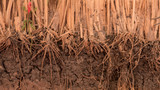
Organically harvested and distilled in Haiti, where it is also helping to prevent the further erosion of valuable mountain soil as a result of deforestation there. Vetiver massively roots itself 20 feet into the eath and by its nature is very grounding. They grow the vetiver in rows perpendicular to the slope, and harvest every third row and then replant, thus they can harvest for essential oil prodution, while still growing vetiver to hold down the soil. It's common now to find vetiver for this use in volcanic soils and mountainous tropical areas to prevent erosion as the roots form a lattice to hold the soil back and prevent it from being washed away.
Deep rooted love and tenacity! The grandfather of big, base, strong and muddy earth-bound strength! Vetiver is the oil you want to have with you when you need to get back to reality, or visit reality, as the case may be. If you need to touch the earth, to feel grounded, to access your inner strength, vetiver is your ticket straight down into the heart of the earth.
Vetiver roots have a long history of use; one of my favorites are the mats woven of dried vetiver, hung in windows and doors, and sprayed with water to cool and freshen the atmosphere during summer months, with the added benefit of keeping bugs away.
Arctander says
First of all, in 1960, when Steffan Arctander compiled this masterwork, Perfume and Flavor Materials of Natural Origin, vetiver was distilled in many places, with the centre being Belgian Congo (which became Zaire and then Congo again, but we can call Kinshasa Congo to differentiate it from the other Congo, which we can call Brazzaville Congo--one of these counties is the Republic of the Congo and the other is Democratic Republic of the Congo and even if you remember which is which, the person you're talking probably probably doesn't, so including the capital in the name makes it clearer for everyone.) As I was saying, in Arctander's time, vetiver was distilled in what was then the Belgian Congo, Angola, Indonesia, Haiti, India, Malaysia, Dominican Republic, Argentina, Jamaica, Mauritius, Martinique, Brazil, and many others, so he's relucatant to make generalized remarks about vetiver and they vary according to geographical location. We shall stick with Haiti, as ours comes from Haiti. Mind you, that description also includes the Congo and Réunion oils. It can also be applied to the Indian vetiver, but at the time of writing, almost all the Indian production went to domestic soap and perfume market so it doesn't have separate description in Artcander's book.
Vetiver oil is an amber colored, to grayish brown, olive brown or dark brown viscious liquid whose odor is sweet and very heavy woody-earthy, reminscent of roots and wet soil, with a rich undertone of "precious wood" notes. Oil distilled from younger roots and some freshly distilled oil might have green potato peel or asperagus note, which is used as a flavoring.
Vetiver is used not only as a fixative and base note, but as an odor contributer in bases of fougère, chypre, modern woody-aldehydic or ambre-aldehydic bases, oriental bases, moss and wood notes, opoponax bases, rose bases, etc. It blends well with ionones, linalool, cinnamon, patchouli, sandalwood, oakmoss, lavender, clary sage, mimosa, cassie, opoponax, etc.
Battaglia:
He lists many other uses of vetiver beside controlling soil erosion: waste water treatment, animal feed, botanical pesticide management, and as a biofuel. Super interesting information.
He goes on to list aromatherapy uses for vetiver:
Musculoskeletal system for muscular pain and arthritis
Psychological as being beneficial for stress, anxienty, insomnia and depression
Reproductive as a hormonal regulator with many indications
Skin care to strengthen the connective tissue and for fatigued skin
Tonic as a neuroendocrine restorative.
Recomended to blend with, depending on the action desired:
Black pepper, german chamomile, kunzea, spike lavender, bergamot, lime, neroli, jasmine grandiflorum, jasmine sambac, patchouli, ylang ylang, lemon, geranium and pine.
Safety Warning
As with most essential oils, dilute before using on skin. Perform a patch test before use if essential oil sensitivity is suspected. Do not take essential oils internally. Do not use on children or pets. Seek advice from a trained aromatherapist before using on people with compromised immune systems. Keep away from eyes and mucus membranes.
Enfleurage makes no medical claims relating to any products, essential oils or otherwise, on our website or through social media. We are an essential oil company, not doctors, The FDA has not evaluated the statements on this website. We present our information in order to educate our customers on traditional and general uses of essential oils; in no way do we diagnose, cure, treat, or prevent any disease or condition.
You the customer are responsible for understanding the safe use of any and all of our products, including essential oils, and use them accordingly.

Vetiver zizanoides
Gramineeae family
Organically harvested and distilled in Haiti, where it is also helping to prevent the further erosion of valuable mountain soil as a result of deforestation there. Vetiver massively roots itself 20 feet into the eath and by its nature is very grounding. They grow the vetiver in rows perpendicular to the slope, and harvest every third row and then replant, thus they can harvest for essential oil prodution, while still growing vetiver to hold down the soil. It's common now to find vetiver for this use in volcanic soils and mountainous tropical areas to prevent erosion as the roots form a lattice to hold the soil back and prevent it from being washed away.
Deep rooted love and tenacity! The grandfather of big, base, strong and muddy earth-bound strength! Vetiver is the oil you want to have with you when you need to get back to reality, or visit reality, as the case may be. If you need to touch the earth, to feel grounded, to access your inner strength, vetiver is your ticket straight down into the heart of the earth.
Vetiver roots have a long history of use; one of my favorites are the mats woven of dried vetiver, hung in windows and doors, and sprayed with water to cool and freshen the atmosphere during summer months, with the added benefit of keeping bugs away.
Arctander says
First of all, in 1960, when Steffan Arctander compiled this masterwork, Perfume and Flavor Materials of Natural Origin, vetiver was distilled in many places, with the centre being Belgian Congo (which became Zaire and then Congo again, but we can call Kinshasa Congo to differentiate it from the other Congo, which we can call Brazzaville Congo--one of these counties is the Republic of the Congo and the other is Democratic Republic of the Congo and even if you remember which is which, the person you're talking probably probably doesn't, so including the capital in the name makes it clearer for everyone.) As I was saying, in Arctander's time, vetiver was distilled in what was then the Belgian Congo, Angola, Indonesia, Haiti, India, Malaysia, Dominican Republic, Argentina, Jamaica, Mauritius, Martinique, Brazil, and many others, so he's relucatant to make generalized remarks about vetiver and they vary according to geographical location. We shall stick with Haiti, as ours comes from Haiti. Mind you, that description also includes the Congo and Réunion oils. It can also be applied to the Indian vetiver, but at the time of writing, almost all the Indian production went to domestic soap and perfume market so it doesn't have separate description in Artcander's book.
Vetiver oil is an amber colored, to grayish brown, olive brown or dark brown viscious liquid whose odor is sweet and very heavy woody-earthy, reminscent of roots and wet soil, with a rich undertone of "precious wood" notes. Oil distilled from younger roots and some freshly distilled oil might have green potato peel or asperagus note, which is used as a flavoring.
Vetiver is used not only as a fixative and base note, but as an odor contributer in bases of fougère, chypre, modern woody-aldehydic or ambre-aldehydic bases, oriental bases, moss and wood notes, opoponax bases, rose bases, etc. It blends well with ionones, linalool, cinnamon, patchouli, sandalwood, oakmoss, lavender, clary sage, mimosa, cassie, opoponax, etc.
Battaglia:
He lists many other uses of vetiver beside controlling soil erosion: waste water treatment, animal feed, botanical pesticide management, and as a biofuel. Super interesting information.
He goes on to list aromatherapy uses for vetiver:
Musculoskeletal system for muscular pain and arthritis
Psychological as being beneficial for stress, anxienty, insomnia and depression
Reproductive as a hormonal regulator with many indications
Skin care to strengthen the connective tissue and for fatigued skin
Tonic as a neuroendocrine restorative.
Recomended to blend with, depending on the action desired:
Black pepper, german chamomile, kunzea, spike lavender, bergamot, lime, neroli, jasmine grandiflorum, jasmine sambac, patchouli, ylang ylang, lemon, geranium and pine.
Safety Warning
As with most essential oils, dilute before using on skin. Perform a patch test before use if essential oil sensitivity is suspected. Do not take essential oils internally. Do not use on children or pets. Seek advice from a trained aromatherapist before using on people with compromised immune systems. Keep away from eyes and mucus membranes.
Enfleurage makes no medical claims relating to any products, essential oils or otherwise, on our website or through social media. We are an essential oil company, not doctors, The FDA has not evaluated the statements on this website. We present our information in order to educate our customers on traditional and general uses of essential oils; in no way do we diagnose, cure, treat, or prevent any disease or condition.
You the customer are responsible for understanding the safe use of any and all of our products, including essential oils, and use them accordingly.
Since 1997, we have been New York’s first and only shop specializing in aromatics from the natural world: essential oils, absolutes and enfleurages. We do not carry synthetics of any kind, in any of our products. In addition to volatile aromatic oils, we offer a carefully curated selection of vegetable and nut oils, hydrosols, and our own range of all-botanical perfumes, skin and hair care, roll-ons to-go, raw incense, hand sanitizer and our new frankincense candles.
Most of our essential oils are sourced from small, artisanal distilleries throughout the world, usually where the plants are happiest growing. The concept of terroir takes the natural planetary variables into account—atmosphere, soil composition, elevation, water table, etc. The earth, as an organic being, moves and breathes with the cosmos, and every square metre of the earth’s tapestry has slight variations. In a larger sense, micro-climates, elevation, soil and air, energy from the sun and moon, rootstock, local cultivation practices, geography, mineral nutrition, water supply, topography, and the like, all influence every living thing growing. Terroir explains the relationship between the scent and taste of a food, wine or essential oil, and its geographic origin.
We’re totally into this.
Domestic Shipping:
Orders over $100 qualify for free shipping within the U.S. We ship domestic orders via UPS Ground or USPS. For deliveries to P.O. boxes, please choose USPS as your shipping option.
US Military Active Duty:
Active duty members of the US military are eligible for free shipping as a token of our appreciation for your service.
International Shipping:
All international orders are shipped via FedEx to ensure reliability and efficiency.
Please be aware that customs and duties may be applied by your country and are your responsibility. These fees are imposed by your government, and the carrier will notify you of any charges. Unfortunately, we cannot assist with these fees, nor can we refund international shipping costs if packages are returned.
Large Orders:
For large orders, over $300, especially initial ones, we may require a signature upon delivery for added security.
Returns:
We accept returns for within 30 days of shipment on unopened products less shipping costs. We do not accept returns on open products.
Please take care when shipping to common areas like general lobbies, or leaving on the doorstep. We cannot refund these orders.
We are not multi-level marketing-our approach is holistic. No membership fees, minimums, or hard sells and we won’t share your information. Just straight-up aromatics.
A quarter-century at the forefront of delivering pure, artisan-crafted essential oils.
Deep-rooted connections with small-scale distilleries around the globe.
Over a decade of distilling premium frankincense, honoring tradition and quality.
Knowledgeable in aromatherapy, perfumery, and ethical sourcing, our staff guide with integrity and expertise.
Join our journey into the heart of botanical luxury. Subscribe for exclusive insights and offers.